
Check the Greeley County Owner of Record
The Greeley County Appraiser keeps the assessment roll. Yet its official page offers no public parcel card and no searchable current-owner field. Request a dated record card from the office instead. Treat that card as a snapshot of the roll, never as an undated statement of title.
| Owner name | The exact owner-of-record value and any co-owner or entity |
|---|---|
| Mailing address | The destination for county correspondence, which may be outside Greeley County |
| Situs | The physical property address, when assigned |
| Legal description | Lot, block, addition or rural section-township-range identity |
| Last sale and deed reference | Transfer date, price or consideration, and instrument reference if the roll carries them |
| Roll date | The valuation year or last-update date needed to judge freshness |
The owner of record may not be the occupant. A trust, lender, or representative can receive the mail somewhere else entirely. Match the parcel by legal description and account number. Only then rely on the name.
Ask about any last-sale date and deed reference the roll keeps. Not every roll carries those fields. A sales entry can sit apart from the owner field, and a transfer price can differ from the Appraiser's value. The record card simply shows today's assessment snapshot.
Request Today's Greeley County Roll Directly
Call or visit first. The Greeley County Appraiser sits at 616 2nd Street in Tribune, and the phone is (620) 376-4057. Weekday hours run 8:00 a.m. to noon and 1:00 to 4:00 p.m. Mountain Time. Give staff the situs and legal description. Ask for the owner field, parcel or account ID, mailing address, valuation year, and roll date.
The county page posts no field labels. It offers no public owner search and no refresh cycle. Asking for labels prevents assuming a sales field or deed reference exists, and it keeps the owner check tied to a dated county response.
Tracy Miller is the Appraiser. Chelsea Guessen rounds out the staff. Keep each request to one parcel, naming only the ownership, location, legal, and date fields you need. That keeps a current roll question apart from an old tax year or a broad research request.
Without a parcel number, bring the standardized street address and the full legal description. The Appraiser's page says nothing about partial addresses, owner-name variants, or old situs formats, so have alternative spellings ready and ask which identifier controls the record. Copy the reply exactly. Include initials, co-owner wording, trust language, and entity suffixes. Those details anchor the Clerk and recorder checks.
The official Appraiser page shows the office route rather than an online form. Phone or counter service carries the request. Learn more at the Greeley County Appraiser page.
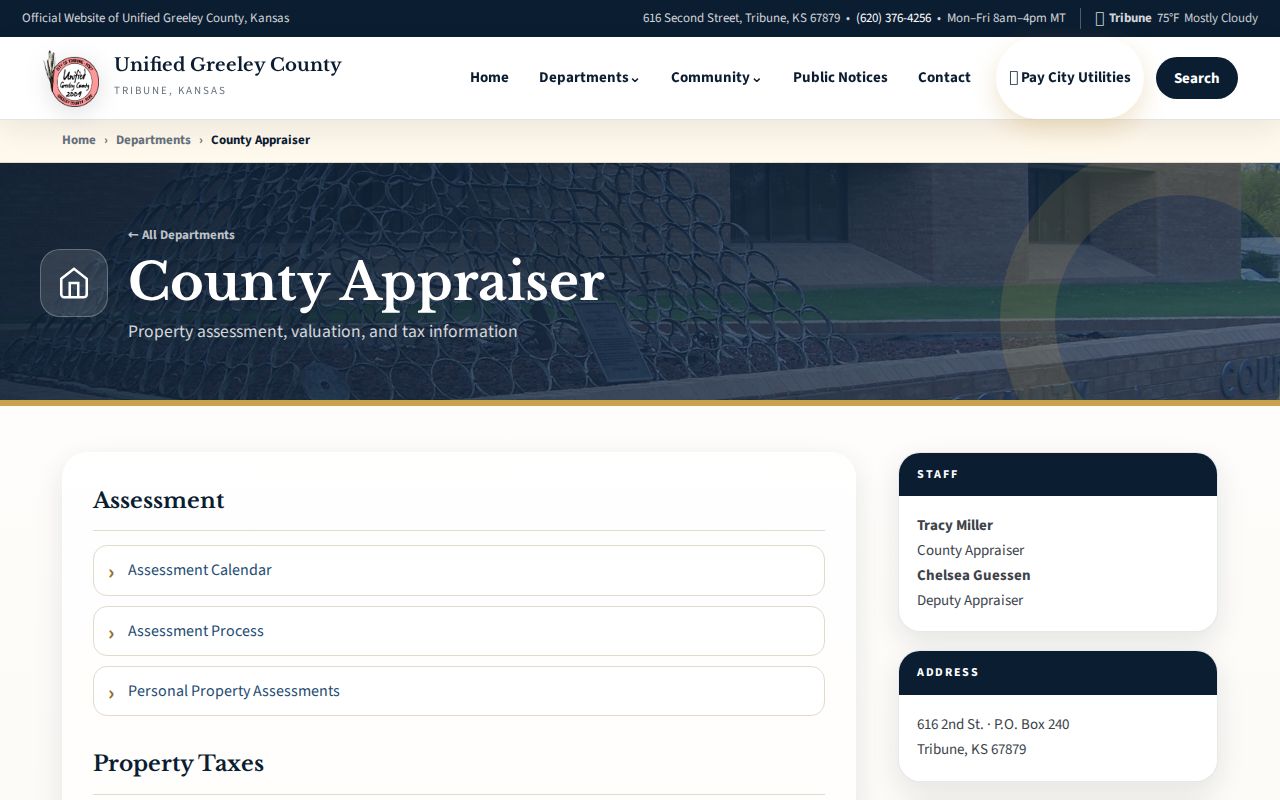
The page offers guidance and contact details rather than a parcel form. Owner research continues by phone or at the counter.
Note: Ask staff how a recently recorded deed is handled before the name appears on the current assessment roll.
Measure the Greeley County Record's Freshness
A deed, the Clerk's transfer file, the Appraiser roll, and a tax account can update on separate schedules in Greeley County. No shared refresh calendar is published. No typical transfer lag is published either. Record each date. When the roll and the deed differ, give greater weight to the latest recorded conveyance.
Freshness matters most after a closing, probate transfer, divorce decree, or death-related transfer, and the County Clerk states its real-estate file incorporates each of those transfer sources. Ask for the source. Ask for the effective date too. Guessing why a name changed helps no one.
The Treasurer's tax account is a secondary check. A payment or mailing name may belong to a lender or representative, and the county publishes no online bill lookup, so keep its tax year separate from the Appraiser's valuation year and the deed's recording date.
Build a log with one row per county source. Add columns for the queried legal description, displayed owner, source date, and transfer reference. If two names differ, call the offices. Ask whether the cause is a pending roll update, a name variant, or a different parcel. Never silently combine the records. The goal is naming which Greeley County owner statement is newest and why, not forcing every system into agreement.
Verify the Current Greeley County Owner
Confirmation is a short present-tense comparison. Keep the same legal description in every step so a similar address or surname does not pull in a different parcel.
- Obtain the owner-of-record value and as-of date from the Appraiser.
- Cross-check the County Clerk real-estate file by address, legal description, and name.
- Ask the Register of Deeds for the newest instrument affecting that legal description and confirm its grantee.
- For an entity name, check the exact business record with the Kansas Secretary of State without treating its agent as the property owner.
- Owner of record
- The party named on a particular dated assessment roll.
- Recording lag
- The interval between recording a transfer and its appearance in another county system.
- Situs and mailing
- The parcel location and the separate address used for correspondence.
Compare the Latest Greeley County Deed
The Greeley County Register of Deeds accepts warranty deeds, quitclaim deeds, easements, mortgages, liens, plats, and other real-property instruments. The office publishes no online grantor-grantee index or image viewer. No coverage year or fee schedule appears online either. Call (620) 376-4275, or visit during weekday hours, 8:00 a.m. to 4:00 p.m. Mountain Time.
Bring specifics with you. Give staff the exact legal description, the apparent current owner, and an approximate recording period. Ask them to identify the newest grantee and flag any correction or re-recording. That step verifies the present owner of record. It avoids a full historical deed-chain search.
Request the index result first, then the instrument itself. Greeley County sources do not state whether staff can search by street address. They also do not say whether a public terminal exists, or whether images can be emailed. Confirm those access details and current copy fees before your visit. Planning ahead saves a second trip.
The deed type alone never settles the current interest. Read the grantee clause, the execution and recording dates, and the legal description. Check any reservations and correction references too. A quitclaim label describes only the instrument's form. It says nothing about the scope or quality of the interest conveyed. Every recorded detail must match the parcel in question.
Freshness matters. The assessment roll may lag a recent sale. The newest recorded deed is the stronger current-owner evidence, though neither substitute is a title opinion.
Read Owner, Mailing, and Situs Side by Side
These three fields answer different questions. The owner value names the party on the tax roll. The mailing field is where notices go. The situs field locates the parcel itself. A mailing address may belong to a trust, a lender, a representative, or an owner living far beyond Greeley County. So it proves neither residence nor occupancy.
Match the description carefully. For a Tribune lot, keep the addition, block, lot, and any vacated-alley language. For rural land, retain section, township, range, tract acreage, easements, and reservations. That legal description is the stable join between the current roll and the deed.
Confirm Entity and Estate Owners in Greeley County
An LLC or corporation in the owner field deserves a second look. Use the Kansas business-entity search to confirm the entity's exact name and status. The tool returns only the first 200 results. It skips many sole proprietorships and assumed names. A registered agent fills a contact role, not automatic ownership.
Probate-based transfers tell a different story. The Clerk's transfer source and the district-court case can explain the current roll entry. Kansas vital records stay restricted. A public court order or a recorded fiduciary deed may supply the property evidence a death certificate would otherwise hold.
Respect Protected Greeley County Addresses
The Kansas Safe at Home program can substitute a legal mailing address for an eligible participant's actual location. So a mismatch may reflect deliberate protection rather than bad data. KORA exceptions and restrictions also limit what a custodian releases and how names and addresses may be used.
Note: Preserve every redaction and never infer a protected physical address from other public fields or related records.
Use Greeley County Owner Records Lawfully
A public mailing field supports legitimate property inquiry. But it grants no unrestricted use. Kansas KORA permits requests for existing records, with actual-cost fees or prepayment allowed. The law preserves its exceptions. K.S.A. 45-230 also restricts certain commercial solicitation uses of public-record names and addresses.
Lawful use. Current owner records can support a purchase, estate, boundary, or easement inquiry. Never use owner information to stalk, harass, intimidate, or harm a person.