
Start a Greeley County Property Records Search
The fastest route follows the record trail instead of a single website. Each office holds one piece. The County Clerk keeps a real-estate file you can query by address, legal description, or name. The Appraiser holds the current valuation roll. The Register of Deeds records the instruments that transfer or burden land, and the Treasurer answers payment and delinquency questions. None of the county pages offers a public record-search form, so preserve every identifier an office hands you.
A street address is a convenient lead. The legal description is the durable link. In Tribune, tract language may name an addition, block, lot, and a vacated alley. Rural land usually needs section, township, range, and acreage. Track the recording date, valuation year, and tax year too, because county files update on different schedules.
- Standardize the address and ask the Appraiser or Clerk for the parcel or account identifier, owner field, legal description, and record date.
- Take the legal description and party name to the Register of Deeds. Ask for the latest conveyance and any linked mortgage, release, lien, easement, or plat.
- Give the account and tax year to the Treasurer. Request billed, paid, delinquent, interest, receipt, and tax-sale status as separate fields.
- For map questions, request the applicable plat or tax-unit map. The available KSDOT county map supplies context, not parcel ownership or surveyed boundaries.
- Order a certified copy when the record must be formally proved, and confirm fees and delivery terms before submitting the request.
For a deeper address, name, and legal-description workflow, use the Search. A result stays a lead. Confirm its date and custodian before relying on it.
Where Greeley County Keeps Property Records
Different courthouse offices answer different questions. The Register of Deeds maintains the official real-estate instruments. The Appraiser maintains valuation and assessment information. The Treasurer collects taxes, while the Clerk keeps a cross-file of real estate by address, legal description, and name. Office pages use Mountain Time, so verify holiday schedules, copy costs, and whether staff require an appointment.
Greeley County Recorder / Register of Deeds
Unified Greeley County Courthouse
Tribune, KS 67879
(620) 376-4275
Greeley County Assessor / Appraisal District
616 2nd St / PO Box 240
Tribune, KS 67879
(620) 376-4057
Greeley County Treasurer / Tax Collector
208 Harper / PO Box 207
Tribune, KS 67879
(620) 376-4413
Greeley County Property Records Begin With the Legal Description
Addresses can change, fail postal checks, or point only to a broad rural site. The legal description is sturdier. It travels with deeds, plats, assessment files, and tax work. In Tribune, record language may identify an addition, block, lot, and a vacated alley; outside town, a request may need section, township, range, quarter section, acreage, or a road reference.
- Grantor and grantee
- The party conveying an interest and the party receiving it in a recorded instrument.
- Parcel or account ID
- The county reference used to join appraisal and tax data; Greeley County has not published its format online.
- Plat
- A recorded plan that creates or revises lots, blocks, streets, alleys, or other mapped interests.
- Situs address
- The physical property location, which can differ from the owner's mailing address.
Ask the office to repeat the complete description, including any addition or townsite name. Small wording changes can separate two tracts that share one street number.
No Single Online Portal Holds Greeley County Property Records
The official county pages describe the records and their custodians. They offer no owner search. There is no address search, grantor-grantee index, tax-bill search, or parcel GIS either. That gap changes the method, not the records themselves. Use the Clerk's address, name, and legal-description file as a bridge. Then contact the office that holds the underlying record.
| Question | First contact | Identifier to give | Freshness check |
|---|---|---|---|
| Who is on the current roll? | Appraiser | Address or legal description | Valuation year and update date |
| Who received title? | Register of Deeds | Grantee plus legal description | Recording date |
| Was ownership transferred through an estate? | County Clerk, then court or deeds office | Name and approximate date | Filing and recording dates |
| Is tax paid? | Treasurer | Account and tax year | Payment date and receipt |
A precise request is easier to estimate. It is also less likely to return records from the wrong year. Ask for plain and certified-copy prices, because the county pages do not publish those fees.
Which Greeley County Property Record Answers the Question
A public property file is a set of records, not one report. A deed documents a conveyance. An appraisal file supports valuation. A tax record tracks billing and payment. A plat supplies recorded geography. Court dockets and legal notices can reveal disputes or sales. Neither alone proves the final owner.
| Record Type | What It Documents | Kept By | Access |
|---|---|---|---|
| Deeds | Conveying parties, legal description, recording reference | Register of Deeds | In-person research; fees not posted |
| Mortgages and liens | Recorded claims, assignments, releases, and easements | Register of Deeds | In-person research |
| Assessment | Class, appraised or use value, assessed value, exemptions | Appraiser | Office request; guidance online |
| Tax | Bill, installment, payment, delinquency, receipt | Treasurer | Office, mail, or drop box; no lookup found |
| Plats and maps | Lot, block, addition, section, and tax-unit context | Deeds and Clerk | Office request; no parcel viewer found |
| Court and notices | Claims, litigation, sale steps, and public deadlines | District Court and newspaper | State portal, terminal, written request, or notice archive |
The recorded instrument is the strongest starting point for a title transfer. The Greeley County deed records guide explains that office process. For current amounts and installment status, the Treasurer is the source. Never treat a parcel map or mailing address as proof of ownership.
Values Across Greeley County Property Records
Kansas property terminology separates appraised or use value from assessed value. A statutory class percentage is applied before a value enters the tax process. An assessed figure is therefore not a predicted sale price. The 2024 state county summary reports about $30.2 million in taxable value. It also shows an average mill levy of 0.258488. Those are county totals, not parcel estimates.
State reporting also listed a 2.528 percent residential land-and-improvement change in a November 2025 analysis. It added a 2.21 percent commercial change from November 2024 through July 2025. These figures describe countywide categories. They cannot show what one home, farm, or business parcel is worth. For a parcel, request the valuation year, class, land, improvements, appraised value, assessed value, and exemptions from the Appraiser. Ask for any sale field as well.
Note: Compare like years and classes, since a county trend, a parcel assessment, and a recorded sale price answer three different questions.
Tax Dates in Greeley County Property Records
The Treasurer mails annual statements in November. The first half is due December 20 and the second half May 10. Late payments add one percent per month plus penalties. Failing to receive a statement does not remove the obligation. Payment is accepted at the office, by mail, or through the courthouse drop box.
The county publishes no public tax-account search. So ask for the exact account, tax year, installment, and billed amount. Ask also for paid amount, payment date, outstanding balance, interest, penalty, receipt number, and any tax-sale or foreclosure status. A delinquent line is not proof of a completed sale. Court orders, statutory notice, redemption, and a recorded deed can all matter later.
Maps Have Limits in Greeley County Property Records
The KSDOT Greeley County map orients a search with K-27, K-96, and section lines. It also marks Horace, Tribune, and city limits. That is where its help ends. It names no owner of record, parcel number, assessed value, recorded plat, or surveyed boundary. Greeley County property records include no online parcel GIS viewer or downloadable layer.
In town, request the recorded plat. Also ask for every later replat, vacation, or dedication touching the legal description. Rural land calls for the section-township-range description. Pair it with the county office map or plat reference. Treat any line on a transportation map as context only. Boundary questions on the ground belong to a licensed survey.
Older land context has its own source. The 1884 Greeley County map page preserves early settlement patterns and routes. Treat it as a research aid, never as a current ownership source.
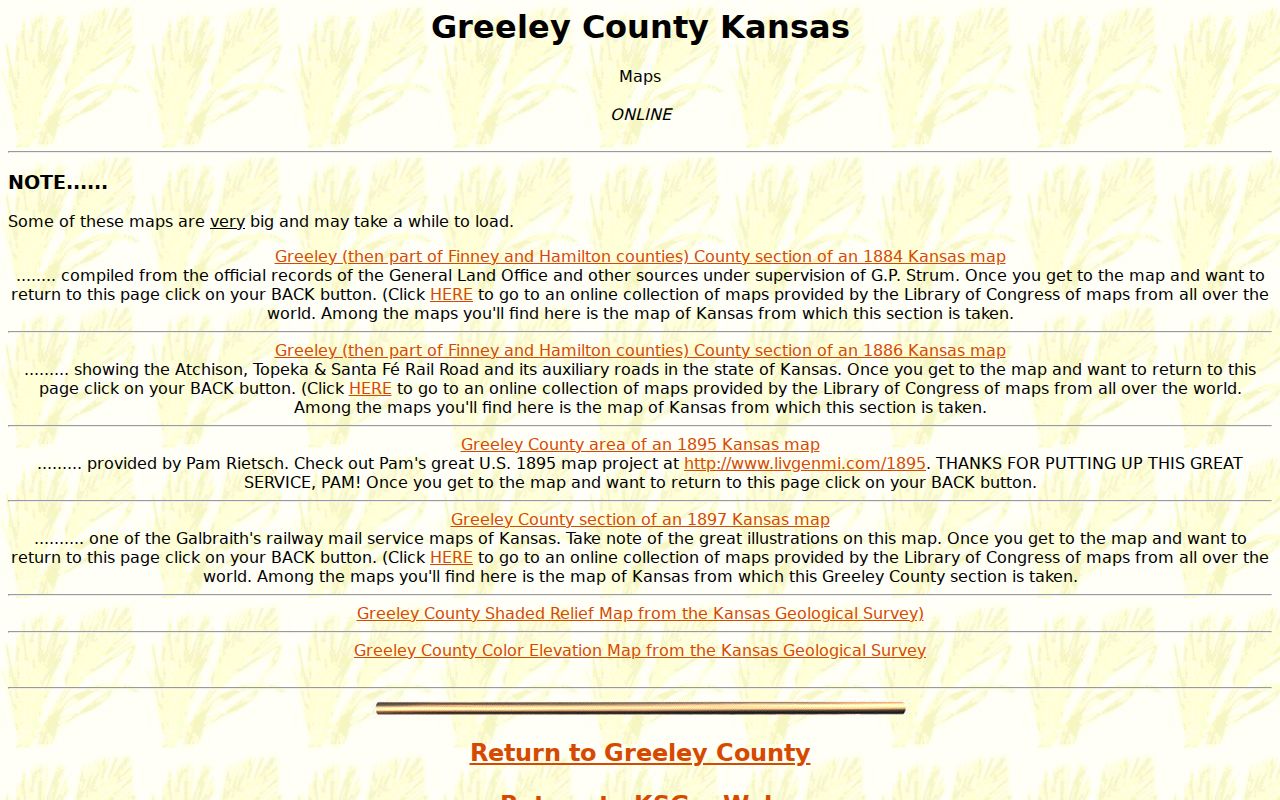
Mine historic maps for place-name and route clues. Then verify the tract against recorded legal descriptions and office-held plat maps before trusting any line.
Tribune First Addition Shows How Property Records Connect
A January 2026 Tribune sale notice offered the south 57 feet of Lots 19 through 24, Block 69, First Addition, along with the north half of a vacated alley. The opening bid was $1,000. Bids rose in $250 steps. A bid sheet and a filing deadline rounded out the terms. That exact wording drives the next search.
The notice itself is not the final ownership answer. Save it first. Then ask City Hall for the bid outcome, the Register of Deeds for the recorded instrument, the Clerk for the transfer entry, the Appraiser for the roll date, and the Treasurer for the tax account. A separate late-2025 notice covered Lots 9 and 10 in Block 103 of the same addition. Exact block and lot strings keep these Greeley County property records searches distinct.
Search tip. Quote “First Addition,” the block, the lot range, and “vacated alley” in a request; do not shorten the tract to a nearby street address.
Legal Notices Date Greeley County Property Records
The Greeley County Republican legal-notice archive collects property sales, mortgage foreclosure notices, budgets, and ordinances. Notices are starting points, not verdicts. For each one, record the publication date, case or ordinance number, parties, legal description, deadline, sale location, and named contact. Then follow it into the court or recorder system.
Foreclosure work may also draw on Kansas CaseSearch and the Greeley County courthouse terminal. Useful docket events include the complaint, lis pendens, judgment, order of sale, sheriff's return, confirmation, redemption, and deed. Portal coverage varies. Document access varies with it. Sealed and restricted records stay unavailable.
Note: A filing or published notice marks a step in a process, not necessarily the final sale, redemption result, or present title.
The Old Courthouse Anchors Greeley County Property Records
Greeley County was established in 1873 and organized in 1888. Temporary offices first operated in downtown Tribune. According to the Horace Greeley Museum, the old courthouse rose in 1889 and 1890. The two-story stone building held a courtroom and a basement jail. Community events used that courtroom as well. Early Greeley County property records grew from both functions.
Search both Tribune and Horace. Early township names, townsites, rail terms, and former post-office names belong in the search too. The Kansas Historical Society lists early newspapers including the Hector Echo, Greeley County Gazette, Greeley Tribune, and Greeley County News. Its catalog searches by keyword, title, creator, or unique ID. Most materials are not digitized.
| 1887 to 1888 | Organization letters survive in Kansas Memory; sources differ between July 6 and July 9 for the organization date. |
|---|---|
| 1889 to 1890 | The old courthouse was constructed and became the physical setting for county and court work. |
| January 1, 2009 | Greeley County and Tribune governments unified; Horace retained its own city council. |
Greeley County property records hold a date conflict worth keeping intact. Do not flatten it into a single year.
An archival request can ask which date marks the legal act, the proclamation, or the recorded organization, letting the deed records speak for themselves.
Limits on Greeley County Property Records and Owner Data
Official Greeley County property records can show a named owner of record, legal description, appraised and assessed values, tax status, deeds, mortgages, liens, easements, and recorded plats. Every item carries its own scope and date. The owner on an appraisal roll may lag behind a new deed. A mailing address may belong to an agent or a trust. A recorded claim may later be released. No single field settles every property question.
Kansas Safe at Home protects eligible participants. It can provide a substitute mailing address and shield a physical address. If an official file shows a protected or substitute address, stop the address chase. Use the program's public contact route instead. The legal description and instrument reference may remain available without exposing a protected location.
Lawful use. Use Greeley County property records for legitimate property research, due diligence, estate work, boundary questions, and civic review. A record lookup is not a title opinion or survey, and owner information must never be used to stalk, harass, or harm a person.
Make a Focused Kansas Open Records Request
The Kansas Open Records Act opens a route when a public record is not available through a routine office lookup. Start by naming the custodian. Then identify the record class, property, date range, and desired format. Ask for a cost estimate. Request any required prepayment and the legal basis for redaction or denial. Kansas guidance calls for action within three business days. That action can be production, denial, or a written delay explanation rather than delivery of every record.
A focused request might seek a specific tax-unit map. It might also target a recorded plat reference, Board minutes on a land-use action, or a bounded list of instruments. Do not call ordinary office research a KORA request. Start with the custodian's normal channel first. Keep a log of contacts, save the dated response, and note the exact request language, delivery format, fee estimate, and any cited exemption. Then the same Greeley County search can be repeated later.