
Fields in Greeley County Property Tax Records
Greeley County splits a property tax question across three offices. The Greeley County Appraiser values parcels and hears appeals, the County Clerk compiles the roll and levies, and the Treasurer bills and collects, so the Appraiser's official page is the natural starting point for valuation questions.
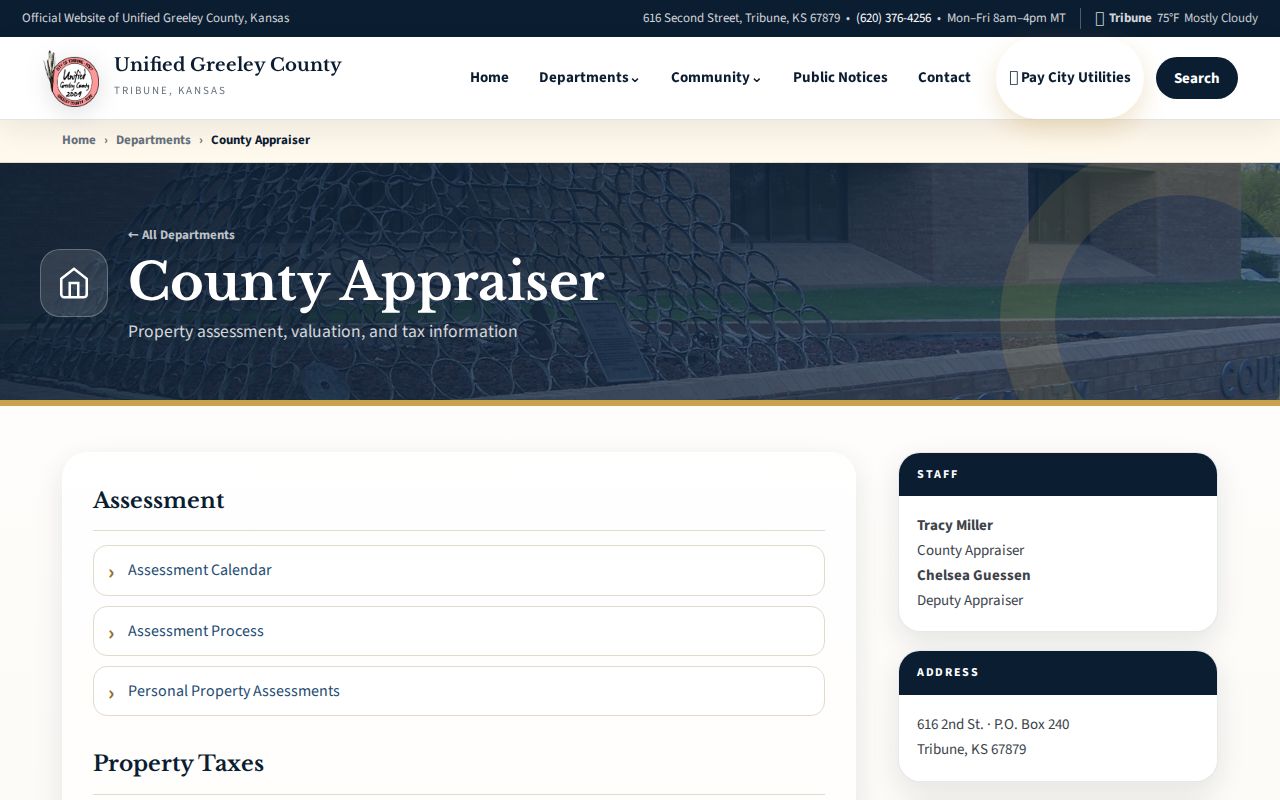
The office page offers guidance but no parcel-search form.
| Field | What It Shows | Where |
|---|---|---|
| Appraised or use value | Valuation before the statutory class ratio | Appraiser |
| Assessed value | Tax base after applying the Kansas ratio | Appraiser and roll |
| Class and exemptions | Classification and applicable treatment | Appraiser |
| Tax bill and status | Amount billed, paid, due, or delinquent | Treasurer |
| Levies and districts | Rates for applicable taxing units | Clerk and Treasurer |
A deed price is a fact of the sale. An appraised value is an opinion. Assessed value is the taxable share of the class. None are interchangeable, and a paid tax account never proves who owns a parcel. The Appraiser page posts no sample parcel card, and its field labels are not confirmed. When requesting Greeley County property tax records, name the fields outright. For the valuation side, ask for the parcel or account ID, valuation year, class, land value, improvement value, total appraised value, assessed value, exemptions, and tax-unit code. Also request any transfer details. For collection, request the tax year, installment, billed amount, paid amount and date, balance, penalty, interest, and receipt number. Field lists prevent crossed answers. A specific request keeps an appraisal reply from being mistaken for a payment reply.
Request a Greeley County Tax Bill
The Treasurer offers no online tax-bill lookup. Call (620) 376-4413 or write to PO Box 207, Tribune, KS 67879, and give the parcel or account number plus the tax year. The office sits at 208 Harper in Tribune, open Monday through Friday from 8:00 a.m. to 4:00 p.m. Mountain Time. Confirm holiday hours before a visit. Also ask whether a balance or receipt request requires identification, prepayment, or a written form. County pages post no fee for account copies. Don't borrow a charge from a court, recorder, or KORA schedule.
- Verify the account identifier and legal description with the Appraiser or Clerk.
- Ask the Treasurer for billed and paid amounts, payment dates, balance, and receipt.
- Ask separately about delinquency, interest, penalty, and any tax-sale status.
- Compare exemptions and class against the same year's Appraiser record.
- Assessed value
- The statutory percentage of appraised or agricultural-use value used as the tax base.
- Mill levy
- The combined rate applied by taxing units.
- Homestead relief
- A state-administered refund or relief route with specific qualifications and forms.
- Tax lien
- A claim for unpaid tax, distinct from completed foreclosure and transfer.
Track each installment and payment on its own line. A single "paid" notation may hide which year or half it covered. A late balance alone doesn't prove foreclosure has begun. Ask the Treasurer for the account's current status. For later legal action or a deed, check with the District Court or the Register of Deeds.
Appeal a Greeley County Assessment on Time
The Kansas tax calendar sets the rhythm. An equalization appeal generally must land within 30 days after a March 1 valuation notice. Informal meetings run through May 15, the Appraiser decides by May 20, and the Board of Tax Appeals deadline falls 30 days after that decision. Follow the dates printed on your notice. Confirm filing details with the Appraiser. The same calendar marks June 1 certification and Clerk abstract dates of July 15 and November 15. Those milestones explain why valuation, roll, and bill records can carry different dates within one cycle. They never extend an owner's appeal deadline. Keep the mailed notice, the envelope if relevant, your filing confirmation, evidence, the informal decision, and any Board correspondence. That paper trail protects your timeline.
Appeal window. Payment under protest is a separate route and ordinarily cannot duplicate an equalization challenge to the same year's valuation; read the state guide before choosing.
Kansas Class Ratios Shape the Tax Base
Class ratios drive the tax base in Kansas. Kansas guidance lists 11.5% for residential property, 12% for vacant lots, 25% for commercial and industrial real property, and 30% of agricultural-use value for farmland. Farm residences stay residential. Agricultural improvements form a separate class. Verify the actual classification before running any math. Note: Recorded consideration, appraised value, agricultural-use value, and assessed value measure different things and never substitute for one another.
December and May Divide Greeley County Payments
Statements go out in November each year. Greeley County sets December 20 for the first half and May 10 for the second. Late amounts accrue one percent per month plus penalties. Pay at the Treasurer counter, by mail, or through the courthouse drop box. A missing statement doesn't waive the tax. Before mailing anything, confirm the balance. Also confirm acceptable payment, postmark treatment, and whether the office wants a coupon or account number. Keep a copy of the statement and proof of payment. Request a receipt number when confirmation matters. A wrong mailing address deserves its own fix. Update the responsible record rather than assuming a forwarded statement changes the parcel's situs or ownership. One bill can bundle several governments. County, city, township, school-district, and other taxing-unit amounts all flow through the Treasurer for apportionment. Ask for the levy or tax-unit breakdown when reconciling a total. The Clerk's levy sheets and tax-unit maps add context. The Treasurer's account still holds the actual billed and paid amounts. Choose the year you pick for those figures.
The 2024 Greeley County Value Baseline
The 2024 state summary lists the countywide taxable value at $30,226,890, ad valorem tax of $7,813,276, and an average mill levy of 0.258488. Residential taxable value came in at $5,817,755, agricultural land at $8,307,543, and commercial real property at $9,166,677. Read these as Greeley County totals. They are not parcel values.
The ratio study drew on seven valid residential sales and put the median ratio at 78.54. That figure grades county assessment performance as a whole, not the worth of any single property. Its coefficient of dispersion was 27.41 and its price-related differential 0.99, and the state reports confidence intervals alongside them. Those technical measures describe a group of assessments. Applying them to an individual Greeley County tax record would be a mistake.
Comparing parcels takes care. Use the same valuation year and the same property class, and look closely at the land and improvement components. Ask whether a sale counted as valid for appraisal purposes, too. A family transfer, a partial-interest conveyance, or another non-market deed can sit in the recorded documents without ever working as a dependable comparable sale.
Greeley County's 2025 Reports Are Countywide
The 2025 numbers are countywide, not parcel-specific. The state residential analysis reports a 2.528% land-and-improvement change. A commercial report gives 2.21% from November 2024 through July 2025. Neither figure replaces a parcel's valuation notice. For a property-level comparison, pull the notice year, class, land, improvement, and total fields.
A countywide percentage can rise while one parcel sits flat. Classification, improvements, land characteristics, corrections, or appraisal judgment can move a single Greeley County parcel differently from the county trend. Compare the old and new parcel fields line by line. Ask the Appraiser what evidence drove the change. Never apply the county percentage as an automatic adjustment to a sale price.
Exemptions and Refunds Require the Right Form
Kansas offers several exemption categories. The Kansas exemption categories page and the state's homestead and relief forms list the current options. Confirm qualifications, evidence, destination, and deadline. The Appraiser can explain parcel classification. State refund rules answer a different question. A local exemption and a state refund are separate paths: ask whether the item is an exemption on the Greeley County property record, a refund claimed through a state return, or another form of relief. Preserve the application year, filing confirmation, decision, and how the outcome appears on the parcel or tax account, and never assume eligibility from age, occupancy, ownership name, or a prior-year result.
Start with facts, not value arguments. A challenged assessment often turns on a field, not a debate. Verify the legal description, parcel class, acreage, land use, and improvement description on the record. Check for property removed but still listed. Check the reverse too: an improvement that existed on the valuation date but never made the record. Ask the Appraiser which valuation year and evidence apply. A corrected factual error and a fair-market-value disagreement can follow different conversations. Both begin at the same office, though. Comparable evidence should match the property type and the relevant valuation period. A deed amount can mislead. Relatives involved, partial interest, multiple parcels, unusual financing, or a non-market circumstance all distort the price. State ratio-study figures summarize county performance as well, so they do not establish a single parcel's value. Organize proposed comparisons by sale date, location, class, land and improvement characteristics, and source. The Appraiser can say which sales count.
Already paying the tax changes the path. Read the Kansas payment-under-protest guide before choosing. State guidance warns that a taxpayer who already challenged the same year's valuation generally cannot use payment under protest. The protest cannot repeat that issue. Confirm the filing deadline. Confirm where the form must accompany payment and which portion must be paid. Delinquency demands its own date-specific verification. Kansas statutes provide publication and foreclosure frameworks for unpaid property tax. Greeley County publishes no online delinquent-tract list, sale calendar, or redemption-status lookup. A missed due date, an old legal notice, or an unpaid-looking balance does not mean a sale is coming. Ask the Treasurer for current account status. Search the 25th Judicial District records for any filed action. The Register of Deeds shows the ultimate conveyance.
A written tax request should lead with identifiers, not names. The owner or account name works only as a cross-check. Names change, but the parcel stays the same. Give the Treasurer the parcel or account identifier, the complete legal description, the tax years, and the exact fields requested. Ask that the response separate original tax, later interest, penalties, payments, reversals, and the current payoff or balance date. If a response uses an unfamiliar code, request its definition.
Compare annual records on a consistent basis. A changed total can mean many things. Value, class, exemption, levy, special assessment, or a corrected account detail can each move the number. Place those components in separate columns. Cite the Appraiser, Clerk, or Treasurer source for each. The comparison will then serve an appeal or purchase review without confusing a countywide statistic with the parcel's actual Greeley County tax bill.