
What Greeley County Deed Records Contain
The Greeley County Register of Deeds is the office that records official instruments affecting real property. A deed places a transfer in the public record. Mortgages, liens, releases, easements, and plats describe the financing, claims, or land rights attached to a parcel. The office directs researchers to visit in person. It publishes no online grantor-grantee database. Start with the official Register of Deeds page for office access.
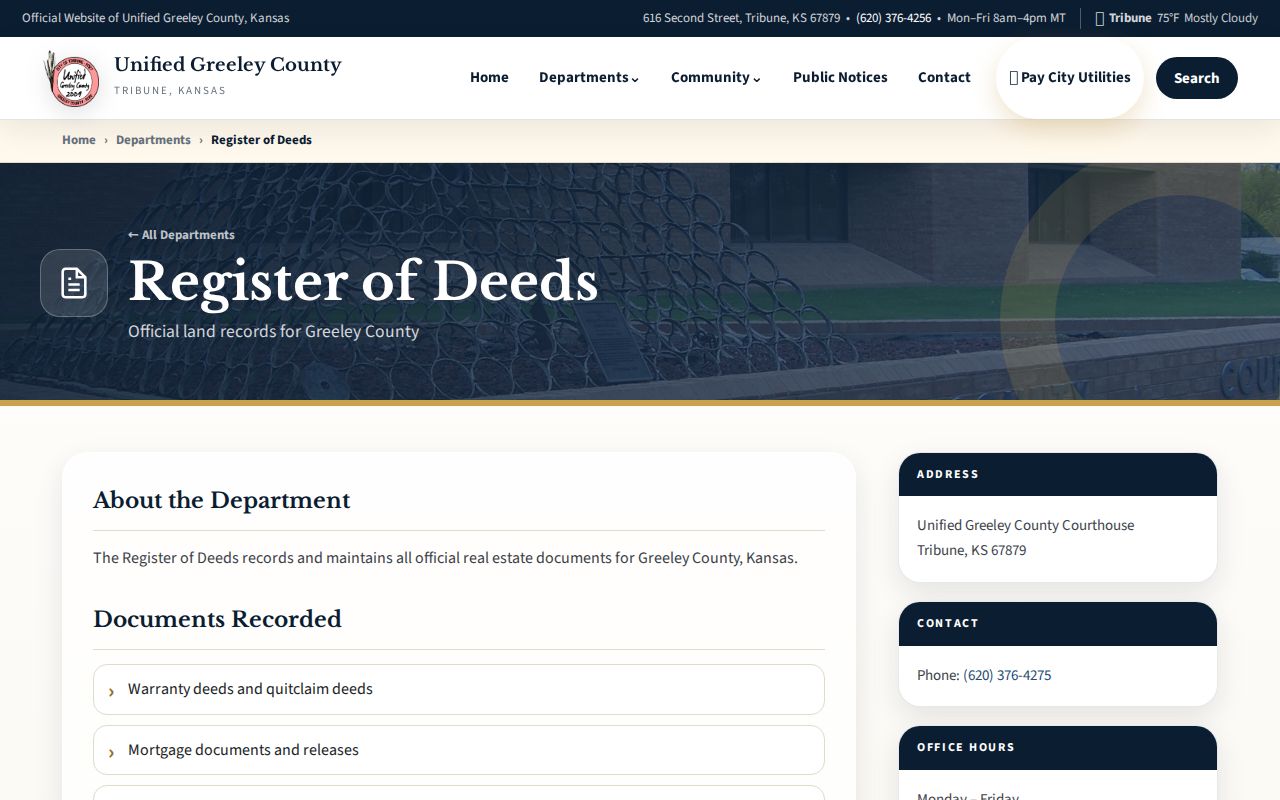
The county page is an access route, not a searchable deed-image portal.
| Deed Type | What It Does | Common Use |
|---|---|---|
| Warranty deed | Conveys the stated interest with deed covenants | Ordinary purchase transfer |
| Quitclaim deed | Conveys whatever interest the grantor has | Family transfer or correcting title |
| Fiduciary deed | Conveys through an executor, trustee, or other fiduciary | Estate or trust administration |
| Sheriff or tax deed | Records a transfer following a statutory sale process | Completed court or tax proceeding |
| Plat or vacation instrument | Defines or changes lots, blocks, alleys, or rights | Subdivision and boundary research |
A mortgage or lien does not convey ordinary ownership. Pull the related releases, assignments, re-recordings, and corrections. Your document set should not stop at an obsolete encumbrance.
Keep the recording date apart from the signing date. Recording places the instrument in the county's sequence, while execution reflects the underlying transaction. When several filings sit close together, copy both dates, every party name, and the document type. Also copy the full legal description. Decide which filing belongs to the tract.
The Courthouse Is the Greeley County Deed Index
Greeley County publishes no online deed index. The parcel number and deed records live at the courthouse. The Register of Deeds in Tribune keeps the official deed books and plat records for Greeley County property records. Call (620) 376-4275 before you go. Ask about hours, holidays, and which office suite handles a property search or a certified deed copy.
| Request field | How to use it | Why it matters |
|---|---|---|
| Grantor and grantee | Search both directions and spelling variants | Connects successive transfers |
| Document type | Specify deed, mortgage, release, lien, easement, or plat | Separates transfers from encumbrances |
| Recording period | Give a bounded date range when known | Reduces false name matches |
| Legal description | Use addition/block/lot or section-township-range | Keeps the search tied to the land |
| Book/page or instrument | Supply the exact locator from an earlier hit | Targets the recorded item |
Missing an online index is a capability gap, not a records gap. The office expressly maintains these records and invites in-person research.
Build a request packet before you go. Include the current owner's spelling and former names or entity suffixes. Add an approximate transfer period. Include the entire description. Ask whether a public terminal, staff-assisted index search, or remote written request exists. The published page does not say. So get the current procedure instead of assuming "in-person research" means a particular terminal or service.
Tribune First Addition Supplies a Search Key
A January 2026 municipal sale notice describes the south 57 feet of Lots 19 through 24, Block 69, First Addition. It also covers part of a vacated alley. That language beats a street address as a deed-records lead. Another notice points to Lots 9 and 10, Block 103, First Addition. Preserve every lot, block, addition, dimension, and alley phrase when asking for the eventual conveyance.
The notice proposes a public sale; it does not report one. Confirm the winning transaction, the resulting deed, liens, taxes, and present owner separately.
This notice-to-deed path works well in Greeley County. Keep the notice date and bid terms. Then request the later conveyance under the same legal description. Compare that instrument with the Clerk's transfer file and the Appraiser's roll date. If no deed appears, do not assume the advertised sale closed.
Mortgages, Releases, Liens, and Easements
Greeley County's recorded land file reaches beyond deeds. For a mortgage, request the original plus any assignments and releases. For a lien, ask for the claim and any release or satisfaction. Easements can burden or benefit land without changing the named owner. A plat, alley vacation, or correction can change how a deed's legal description should be read.
Follow every reference. An unreleased-looking instrument may have a later release under a different date or document number, so ask the recorder to identify linked filings.
Walk the Greeley County Grantor-Grantee Chain
The grantor transfers; the grantee receives. The index bridges names and recorded documents. The legal description confirms that similar names involve the same tract.
- Ask the Clerk or Appraiser for the current name and exact legal description, then locate that party as grantee.
- Read the grantor, recording date, instrument type, and book/page or instrument number from the matching deed.
- Search that grantor as an earlier grantee, confirming the same legal description at each step.
- Repeat backward and flag probate, divorce, corrections, replats, or name variants that interrupt a simple sequence.
- Grantor
- The party transferring the stated interest.
- Grantee
- The party receiving the stated interest.
- Chain of title
- The chronological sequence of instruments associated with the same land.
- Book/page or instrument number
- The recorder's locator; ask which system applies to the particular era.
Older Greeley County Deeds Need Historical Place Names
The published county history sets organization in 1888. Kansas Historical Society and Kansas Memory material splits between July 9 and July 6. That discrepancy is worth keeping intact in your citations. Early searches may involve Tribune or Horace townsites. Colony, Harrison, or Tribune township may also appear. Former post-office names can matter too.
The Kansas Historical Society archives supports catalog and research-room follow-up. Its newspaper holdings include the Hector Echo, Greeley County Gazette, Greeley Tribune, and Greeley County News. Most catalog records are not digitized. Use newspapers to surface a party name, date, or legal phrase. Then return to the deed book.
The recorder publishes no earliest deed-book year or digitization cutoff. Ask the office about the earliest direct and reverse indexes. Also ask whether older books, microfilm, or plats must be viewed onsite.
Cross-Check the Clerk and Appraiser Files
The County Clerk keeps a real-estate file searchable by address, legal description, or name, with ownership updated from deeds, probate, divorce decrees, and death certificates. The Appraiser maintains the valuation and assessment side. Check each record's as-of date, since a freshly recorded Greeley County deed often reaches one office before the other.
A Clerk transfer entry can look odd at first. The ownership change may stem from probate, a divorce decree, or a death transfer rather than a conventional sale. Ask for the transfer source and date. Those details can lead you to the recorded deed or the related court file. Treat the Clerk's cross-reference as a pointer, never as a stand-in for the deed itself.
For general lookup mechanics, use the Search. The former owners guide covers a backward historical chain.
Note: A tax mailing address may belong to a representative, lender, or out-of-county owner and does not establish parcel location or occupancy.
Request a Greeley County Deed Copy
Give the Register of Deeds the party names, legal description, approximate recording period, and document type, plus the exact book/page or instrument number if known. Ask for an index check first. Then specify a plain or certified copy. The official Greeley County page publishes no per-page, certification, search, mailing, or electronic-delivery fees, so get a current quote and payment instructions straight from the office.
Travel is not always practical. Ask whether staff accepts a written or mail request, and whether inspection, electronic delivery, or prepayment is an option. A focused request beats a broad sweep. Broad address sweeps rarely help. Keep the office response, the copied deed, and the source date together.
For a plain copy, identify the instrument precisely and state whether an emailed scan, a mailed paper copy, or an onsite visit will do. For a certified copy, say so before the office prepares it, and ask about certification, postage, and payment rules. Greeley County publishes neither fee. Another Kansas office's quote is no substitute. Local research time, media, and delivery costs may differ.
Without a document number, separate the search from the copy order. Ask for grantor and grantee index entries first. Include the date range, instrument types, and legal description. Review the references that come back. Select the item before ordering pages. This step keeps a common name from dragging in unrelated instruments and makes it easy to request a linked release, assignment, correction, or re-recording at the same time.
For older deed records, check the index coverage. Ask which direct and reverse index covers the period. Also ask whether the source is a bound book, microfilm copy, or later electronic image. Copy the index citation even if the document cannot be delivered right away. If the description cites Horace townsite, a former post office, railroad language, or an early township name, preserve that wording. Do not modernize it to a guessed street address.
Reconcile the copy against your question. Confirm the parties, execution and recording dates, legal description, document type, and every cross-reference. If the deed points to a plat, easement, earlier book/page, probate matter, or correction, pull that source too. Compare the latest deed date against the Clerk transfer file and the Greeley County Appraiser roll. Different as-of dates explain most apparent conflicts. An unresolved break belongs with a qualified title professional.
Recorded, not guaranteed. Greeley County deed records show instruments accepted for recording; they do not establish that title is clear or disclose every possible unrecorded interest.