
Trace Back Greeley County Former Owners
Work backward from the newest reliable transfer. That is the whole strategy. Greeley County posts no online grantor-grantee index and no published start year, so the chain gets built at the Register of Deeds. When the trail moves beyond the current files, the Clerk, plats, historical catalogs, and newspapers take over.
| Transfer date | Grantor to grantee | Instrument | Reference to capture |
|---|---|---|---|
| Newest recorded date | Previous owner to current grantee | Warranty, quitclaim, fiduciary, or other deed | Book/page or instrument number |
| Prior recorded date | Earlier owner to that previous owner | Earlier conveyance | Book/page, legal description, and recording date |
| Earlier deed-book era | Historic grantor to historic grantee | Bound volume or microfilm entry | Volume/page and index spelling |
| Townsite or plat event | Developer, railroad, municipality, or lot owner | Plat, replat, alley vacation, or easement | Plat name and recording reference |
Each row hands you the next name. That party becomes the grantee in the next older deed. Preserve the legal description. A modern street number may never appear in early Tribune or Horace instruments.
Never skip non-sale instruments. A quitclaim, fiduciary deed, correction, re-recording, or plat event can explain a sudden name change. It can also explain a description change. Mortgages and releases help pin down timing. They do not place anyone in the ownership chain by themselves.
Begin With the Current Greeley County Grantee
The current owner of record anchors the entire search. Start with the Appraiser or County Clerk. Ask for the owner name, parcel or account number, legal description, and the date of that source. Take the name and description straight to the Register of Deeds next. The newest deed should name today's grantee along with the grantor who transferred the interest.
The county's official sources publish no searchable deed portal, index coverage year, or image service. An office request is therefore essential. The parcel may be a Tribune lot and block. It may be a Horace townsite parcel. It may be rural land described by section, township, and range. Say which it is.
Call the Register of Deeds at (620) 376-4275. Published hours run Monday through Friday, 8:00 a.m. to 4:00 p.m. Mountain Time. Ask about appointment needs, research access, payment methods, and plain or certified copy costs. The county page posts no fee schedule.
Shape the request as a compact research packet. List every known grantor and grantee spelling. Include the exact property description, city or township, and the approximate recording span. Note the instrument types you want. Ask staff to flag assignments, releases, corrections, and re-recordings tied to each deed. An index entry may point to a volume or instrument. Note that reference before requesting the image. This keeps the search narrow when fees or staff-research time apply. It also stops an unrelated owner with a similar name from slipping into the chain.
The Register of Deeds page that directs researchers to the office appears below.
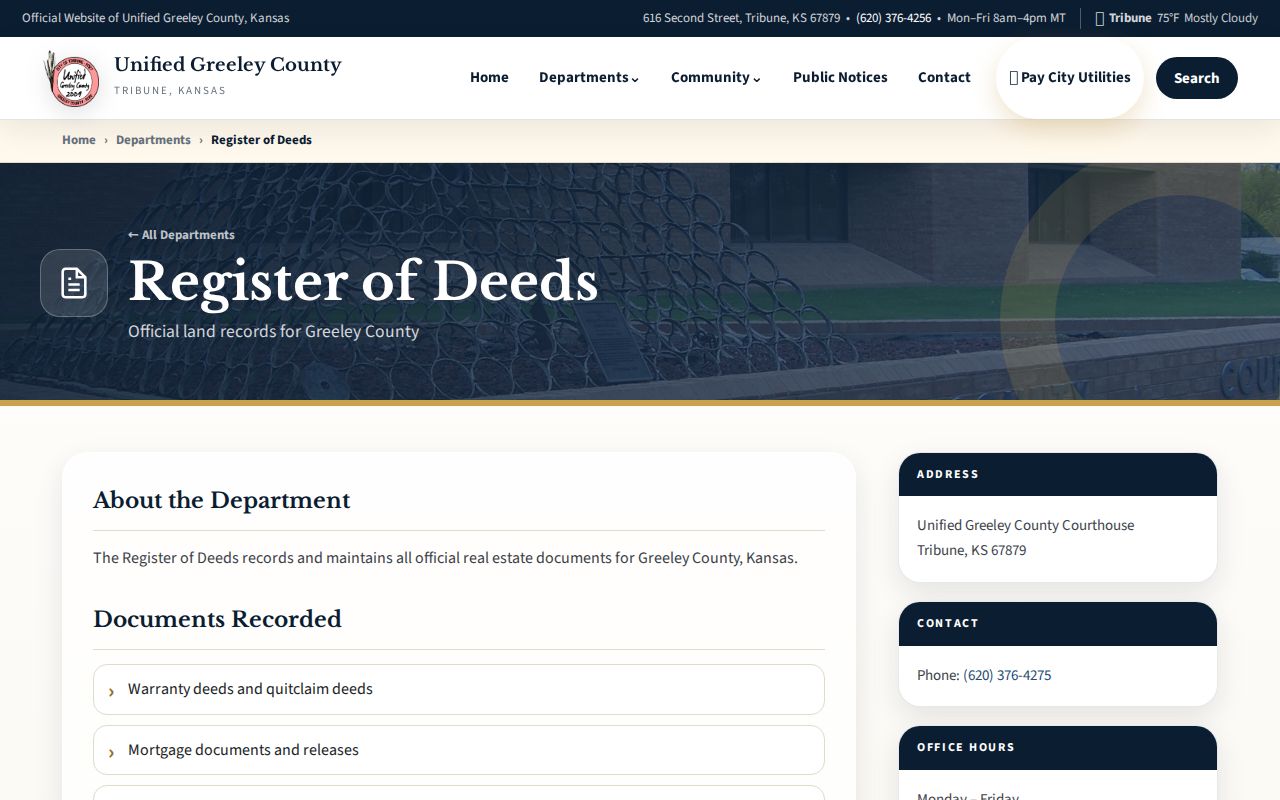
The office records far more than deeds. Mortgages, releases, liens, easements, plats, and related instruments all pass through it, giving the backward chain more context than owner names alone.
Reconstruct the Greeley County Deed Chain
Read every transfer in reverse chronological order. A working table of names, dates, deed types, legal descriptions, and references keeps the next step grounded in evidence rather than guesswork.
- Locate the current grantee's acquiring deed and copy its full legal description and reference.
- Read the grantor name from that deed; this party was the immediate prior owner.
- Search that grantor as an earlier grantee, testing initials, entity suffixes, and spelling variants.
- Repeat until the desired era, then ask for the reverse index, tract index, deed books, plat books, or microfilm.
- Grantor and grantee
- The transferring party and receiving party named in a deed.
- Chain of title
- The ordered sequence of instruments affecting the same land.
- Reverse index
- An index used to find a party in the receiving role before following that party backward.
- Warranty and quitclaim
- Different deed forms that require reading the actual instrument, not assumptions from the label.
Use Legal Descriptions Across Greeley County Eras
Street names change. Mailing formats change too. The recorded land description is what carries the chain. Tribune instruments may use addition, block, lot, and alley language, while rural deeds lean on section-township-range calls, tract acreage, reservations, and easements. Horace's railroad-era records bring townsite, depot, right-of-way, and company terms.
A 2026 Tribune sale notice shows how precise these descriptions get. It covered the south 57 feet of Lots 19 through 24 in Block 69, First Addition, plus a vacated-alley tract. Treat such a notice as a lead only. It proves neither the bid result nor the current owner. Confirm any resulting conveyance in the deed record itself.
A separate late-2025 notice points to Lots 9 and 10 in Block 103, First Addition. Keep the two descriptions apart. Searching by city name alone can tangle unrelated parcels. Precise block and lot terms keep the historical chain clean.
Vacated alley language deserves a search of its own, because it can reshape the described footprint and the adjoining tracts. Ask whether the vacation was recorded separately and whether a replat or later deed absorbed the strip. Rural land needs the same discipline. Watch road rights-of-way, mineral reservations, and tract acreage there. Each change belongs on the timeline at its recording date, never projected backward onto older ownership.
Note: Search Block 69, Lots 19-24, First Addition, and vacated alley separately when an exact phrase produces no index hit.
Follow Greeley County Estate Transfers Back
Estates can break a simple sale-to-sale chain. Probate and fiduciary transfers explain many of the gaps. The County Clerk's real-estate file records transfers from deeds, probates, divorce decrees, and death certificates. Ask the Clerk for the transfer source. Then try the courthouse and the Kansas District Court CaseSearch. Use both to find an estate case. Look for an order of sale, final settlement, or fiduciary.
Back at the recorder, request the fiduciary deed, affidavit, order, or other recorded instrument. Kansas death certificates are restricted. Public court and deed records are often the sounder route. Keep the decedent's name variants, case number, fiduciary name, and legal description together.
Track Plats, Alleys, and Greeley County Changes
An old deed description can stop matching the parcel it once described. That drift often traces back to a plat or an alley vacation. So ask the Register of Deeds for historic townsite plats, replats, street and alley vacations, and easements. Ask also for any cross-reference pointing to a later instrument. The county publishes no online plat-book index. Confirm the physical and microfilm holdings with that office directly.
Never force historic language onto a current map. The KSDOT county map does show roads, section lines, Tribune, and Horace. But it carries no parcel ownership and no cadastral detail. Treat it as geographic context only, and leave the ownership chain to the deed records.
Extend Former-Owner Research Into Local Archives
The Kansas Historical Society archives opens catalog access to government records, manuscripts, newspapers, and local-history collections. It also offers research-room access. A catalog hit, though, does not promise a digital image. Early Greeley County newspaper microfilm can yield names, notices, and description clues. So can the Greeley County Republican legal archive. These details sit between recorded events.
Treat these sources as corroboration, never as conveyances. Even two state-history sources disagree on the July date of Greeley County's 1888 organization. Preserve that conflict instead of picking a winner. The deed books remain the only place the former-owner chain advances.
The courthouse built in 1889 and 1890 offers another lead. Museum or archive material may surface contracts, board minutes, bonds, or photographs. Such finds enrich a property history. Still, only a matching recorded instrument moves the deed chain forward.
Old newspaper references also explain surprising deed-book entries. A surname, company, or townsite may turn up there. Search the Republican archive by exact legal-description fragments and party names. Note each publication date and notice type. A foreclosure, municipal sale, or estate notice may point to a court case. It may also point to a later conveyance. The notice alone, however, proves neither that a sale closed nor that title changed.
Find Greeley County's Earliest Ownership Record
No official source states when the deed index begins. Nor does it say which book survives earliest. It is unclear how far the microfilm spans, or whether a records-loss cutoff exists. Those are questions for the recorder. Ask about the earliest grantor and grantee indexes. Ask also about deed books, tract and township indexes, townsite plats, and microfilm holdings. If any material moved to an archive, request the collection name and call number.
The former-owner trail ends where the evidence ends, not at some assumed online cutoff. A failed web search is not a missing record. Document every gap, and let the surviving property records speak for themselves.
Coverage is not published. Greeley County gives no verified online cutoff year. Ask for the earliest index and continue through deed books or microfilm without inventing dates.