
Identify Who Owns a Greeley County Property
Greeley County publishes no countywide parcel-search form or online deed index on its official pages. The owner search therefore runs office to office. Start with the strongest location key, pull the current roll details, and confirm the name against the recorded transfer. One mailing label is never proof by itself.
- Standardize the situs address and ask the Greeley County Appraiser for the parcel or account number, legal description, owner-of-record value, valuation year, and roll date.
- Ask the County Clerk to match that address, legal description, and name in its real-estate transfer file.
- Take the exact parties and legal description to the Register of Deeds, then identify the latest recorded instrument and its grantee.
- If the grantee is an entity, compare its exact name with the Kansas Secretary of State business search. Do not substitute an agent's address for the parcel situs.
This sequence answers the question with dated evidence. It also resolves spelling differences and freshly recorded transfers.
For a Tribune parcel, copy the addition, block, lot, and any alley language exactly. Rural tracts demand more detail. Keep the section, township, range, acreage, reservations, and easements. A Horace instrument may preserve a townsite or railroad-related name that no longer matches the present street address. These descriptions hold the same Greeley County land in view as the search moves between offices.
Request the Greeley County Owner Field
The Appraiser page names Tracy Miller and lists an office request route. It displays no searchable parcel card. Ask for the actual current owner field. A broad question about an address invites guesswork. Include the parcel or account ID when known, along with the situs, legal description, mailing address, valuation year, and last-update date.
The page also publishes no refresh cycle. That gap matters right after a sale. Record the roll's as-of date, and do not call the listed person or entity current until the newest deed has been checked.
If the office response omits a field, ask whether it is unavailable, held under a different label, or excluded from the public copy. A blank value is not a conclusion. The county publishes no sample cards. Only staff can confirm the current card layout.
Contact details for this request sit on the county Appraiser page.
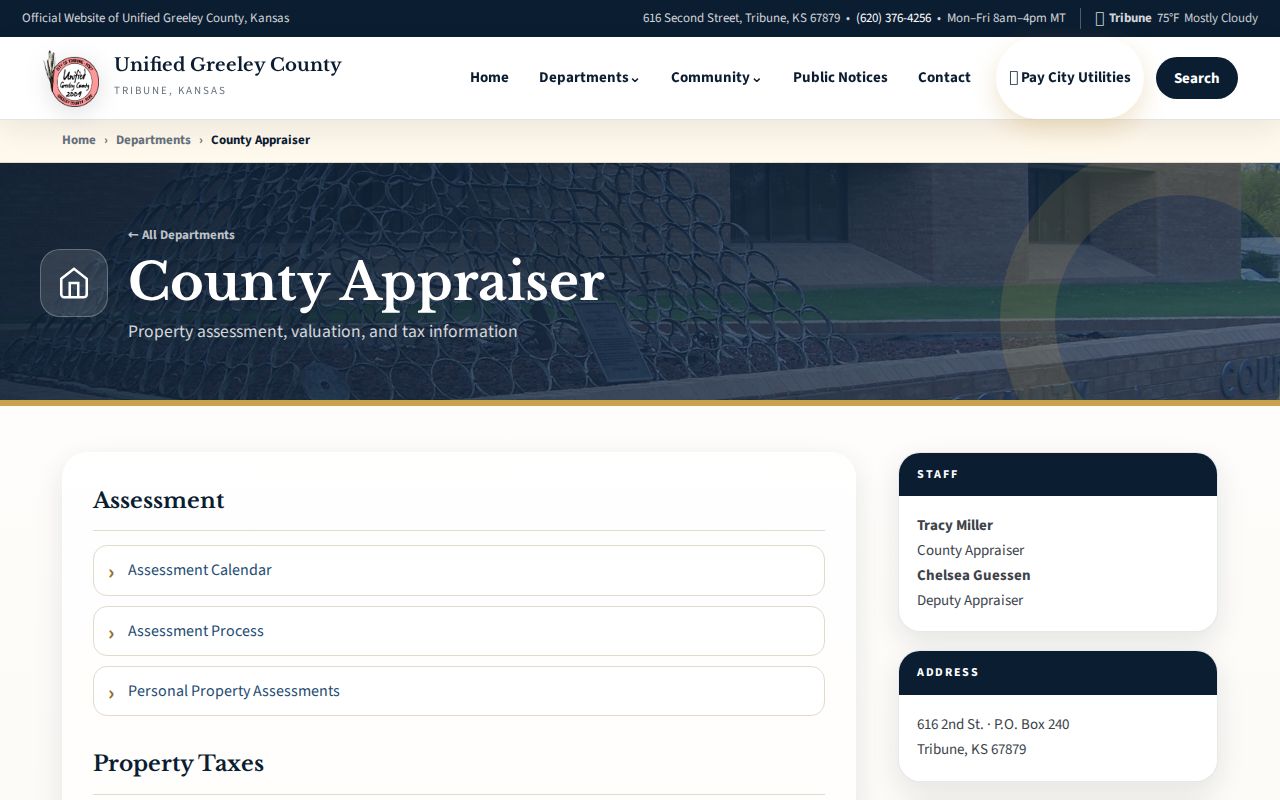
The image confirms an office-centered access path rather than a public owner-search interface. A phone or in-person request remains essential.
Note: Ask for the valuation year and roll date because Greeley County does not publish a shared refresh schedule.
Trace the Name to Greeley County's Latest Deed
The roll offers a practical name. The deed supplies the transfer evidence. Give the Register of Deeds the exact legal description, the owner or grantee spelling, an approximate recording period, and any book, page, or instrument number already found. Ask staff to inspect both grantor and grantee indexes and flag corrections or re-recordings.
The Register of Deeds publishes no web index or image viewer. No coverage start year or copy-fee schedule appears either. That limits remote access only. The deed still exists. The office records warranty and quitclaim deeds, mortgages and releases, liens, easements, plats, and other instruments affecting Greeley County real estate.
Call (620) 376-4275 or visit during weekday hours of 8:00 a.m. to 4:00 p.m. Mountain Time. Confirm the details first. Ask about the physical suite, appointment expectations, plain or certified copies, payment methods, and current charges. The county publishes no fee schedule. Do not borrow state court or KORA fees as substitutes.
The owner of record appears on a dated government roll. A grantee receives the interest a deed conveys. Situs is the property's location, a mailing address is where notices go, and title is the legal interest itself rather than a database label.
Use the Greeley County Clerk as the Cross-Check
The County Clerk holds a distinct local role. Its real-estate file is maintained by address, legal description, and name. The office records ownership changes drawn from deeds, probates, divorce decrees, and death certificates. That broader trail explains why a simple deed-name search can look incomplete.
A focused request names the property first. Then ask for the current real-estate entry. Ask for its transfer source and the effective or update date too. The Clerk's page posts no online index or stated coverage period. Ask about inspection, copies, and fees before sending a large request.
A KORA request must describe an existing record. Kansas agencies should act as soon as possible. That means no later than the third business day. Otherwise they must give a detailed delay explanation. Reasonable actual-cost fees and prepayment can apply.
Note: A Clerk transfer entry supports the ownership trail, but the underlying deed or court order may remain with another custodian.
Where Greeley County Property Ownership Appears
Each source answers a different slice of the property owner question. The safest reading pairs every name field with its date and purpose.
| County source | Ownership clue | How to reach it |
|---|---|---|
| Appraiser roll | Requested owner of record, mailing, situs, legal description, valuation and roll date | Contact the Appraiser; no public parcel form located |
| County Clerk file | Real-estate ownership and transfer source by address, legal description, or name | Office request; no web index located |
| Register of Deeds | Newest grantee and recorded legal description | Research in person or contact the office |
| Kansas SOS | Entity status and registered-agent context for an LLC or corporation name | Public entity search; first 200 results displayed |
None of these records proves who occupies the land. A mailing address may belong to an out-of-county owner, lender, trust, or representative, while the situs stays in Greeley County.
Read Greeley County Trust and Entity Names Carefully
Greeley County deeds do not always name a person. An LLC, corporation, or trust can stand in as the grantee instead. Keep every suffix and punctuation mark exact. Ask the recorder or Clerk to run a search that way. The Kansas business database lists corporations, LLCs, LLPs, and foreign entities. Sole proprietorships, DBAs, and assumed names are not all covered.
A registered agent or business address from the Secretary of State is context only. It does not prove that a natural person owns or lives at the parcel. With a trust, check whether the recorded deed names a trustee. Check too whether a later instrument changed the vesting. The real answer ties back to the recorded instrument. It also ties back to the parcel's legal description.
Follow Probate and Death Transfers in Greeley County
A death can break a tidy address-to-deed chain in Greeley County. Estate transfers are exactly what the Clerk records, including probate matters and death certificates. Begin with the last recorded owner of record. Then search the Kansas District Court CaseSearch by name for an estate or title proceeding. Finally, ask the recorder about any fiduciary deed, affidavit, order, or other transfer instrument.
Kansas vital certificates are restricted. Eligibility and identification are required to get one. Often a public court order answers the ownership question. A recorded property instrument can do the same without that certificate at all. Keep the estate case number, fiduciary name, parcel legal description, and recording reference handy throughout.
Know When Tax Status Is Not an Owner Answer
The Treasurer's account can reconcile a parcel or mailing name in Greeley County. Payment status, though, proves nothing about title. Statements go out in November, and payment is accepted in person, by mail, or through the courthouse drop box. The county publishes no public online tax-bill lookup.
Treat the tax account as one separate, dated check. A payer might be a lender or a representative. An old mailing label can even survive a transfer. For a direct route to the owner of record, the Appraiser roll, the Clerk transfer file, and the latest recorded deed in the deed records carry far more weight than any tax bill.
Protected Greeley County Addresses Stay Protected
Kansas Safe at Home gives eligible participants a substitute legal mailing address and shields the physical one. A public mailing field in Greeley County property records may therefore differ from a person's residence on purpose. The Kansas Attorney General administers the program.
KORA carries exceptions and use limits of its own. K.S.A. 45-230 restricts certain commercial solicitation uses of names and addresses, and a custodian may request a certification under K.S.A. 45-220. Ask for property records narrowly. Respect every redaction.
Limits on Who Owns This Property in Greeley County
A roll entry or a deed-index name is not a title opinion. It can omit unrecorded interests. It can lean on a prior legal description, or lag behind a recent transfer. Occupancy is not established by it either. For a purchase, estate, boundary, or easement question, treat Greeley County property records as leads. Get qualified title help where the stakes call for it.
Owner lookup limit. An owner name on a Greeley County roll is not proof of title and may represent an LLC or trust. Use public records only for lawful property research, never to stalk, harass, intimidate, or harm anyone.