
Compare Greeley County Property Value Types
A Greeley County property carries several numbers. The county appraisal, the statutory tax base, and the consideration in a deed each answer a different question, so none of them can stand in for the others.
| Value type | Meaning | Record location |
|---|---|---|
| Appraised value | The county valuation opinion under Kansas fair-market-value law | Appraiser roll |
| Assessed value | The taxable base after applying the statutory class percentage | Assessment record |
| Agricultural-use value | The use-based figure for agricultural land | Appraiser agricultural record |
| Sale consideration | A transaction fact that may be non-market, partial, or old | Recorded deed and any sales field |
Kansas assessed value starts from a class percentage. It applies to appraised value, or to agricultural-use value on farmland, so it will not match a full appraisal or a recorded sale price. The gap is normal. Exemptions and further adjustments can change the taxable figure once more. Keep that number distinct from assessed value unless the Appraiser confirms the fields coincide. One label cannot safely stand in for another.
Apply Kansas Ratios to Greeley County Values
Residential real property is assessed at 11.5% of appraised value, vacant lots at 12%, and commercial or industrial real property at 25%. Agricultural land is assessed at 30% of agricultural-use value. Farm residences remain residential, and agricultural improvements occupy a separate class.
These percentages classify the tax base; they do not predict a sale. Confirm the property class, land, improvements, total appraised value, assessed value, exemptions, and valuation year with the Greeley County Appraiser.
K.S.A. 79-501 supplies the fair-market-value framework, while K.S.A. 79-1439 defines class assessment ratios. Reading both prevents a common mistake: multiplying or dividing a figure without first confirming its class and whether agricultural-use valuation applies.
For a simple residential illustration, the statutory relationship means an appraised figure and an assessed figure should be read as two stages of the same tax process, not competing estimates. The same arithmetic cannot be carried over to commercial property, vacant land, or agricultural-use land because their percentages and valuation bases differ. Before doing any calculation, verify the current classification and whether a mixed-use parcel has more than one component.
Appraised value is the county's opinion. Assessed value is the class-adjusted tax base. The assessment ratio is the statutory percentage, sale consideration is the price stated in a deed, and reassessment is a later valuation update.
Estimate Greeley County Assessed Value From the Roll
Greeley County offers no public parcel-search form or sample value card, so the lookup begins with a request to the Appraiser. Keep every number beside its label and year.
- Give the Appraiser the situs, legal description, and parcel/account number if known.
- Request class, land, improvements, total appraised, assessed, exemptions, valuation year, and any sales fields.
- Confirm which figure is appraised, assessed, agricultural-use, or taxable after exemptions.
- Compare any sale field with the latest recorded deed and ask whether the sale was qualified.
- Assessed value
- The class-adjusted taxable base.
- Appraised value
- The assessor's valuation opinion before the class percentage.
- Ratio
- The statutory percentage connecting the two.
The official Appraiser page is shown below.
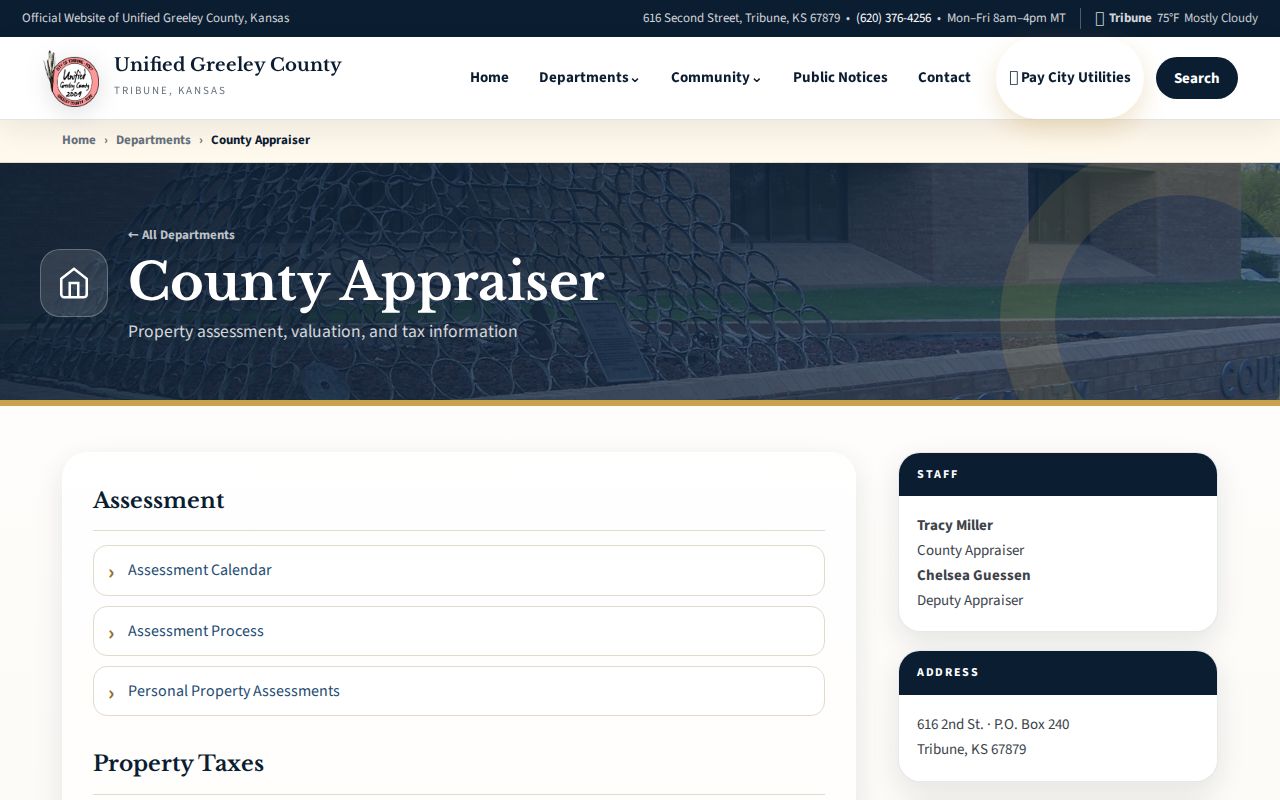
The Appraiser's page offers office guidance but no public value-history search, so a dated request is the reliable route. The office sits at 616 2nd Street in Tribune. Its listed number is (620) 376-4057. Published hours run 8:00 a.m. to noon and 1:00 to 4:00 p.m. Mountain Time on weekdays. Confirm access before traveling. Ask whether copies or emailed answers cost extra.
When a value field is blank, suppressed, or unfamiliar, ask staff to explain it rather than reading it as zero. Request the assessment class and tax-unit code as well. Both help interpret the record. For a parcel with several uses, ask whether land and improvements are split into components. The county page shows no sample card, so exact labels and display order come only from the live record staff supply.
Read Greeley County Land and Improvements Apart
A requested parcel card should separate land, improvements, and total appraised value when those fields are maintained. That split shows whether a change came from the land, the buildings, a reclassification, or a broad valuation update. Exact labels are not published online. Ask staff to define them.
On agricultural land, never substitute a market estimate. A farm residence stays residential even when the acreage around it follows agricultural rules. Class ratios differ too. A vacant lot at 12% and a commercial parcel at 25% cannot be compared directly with a residential assessed total, so confirm like classifications before reading any appraised values side by side.
Place Greeley County's 2024 Baseline in Context
The 2024 state county summary reports $30,226,890 in taxable value. The average mill levy is 0.258488. Residential taxable value was $5,817,755. Agricultural land came in at $8,307,543, and commercial real property at $9,166,677.
These are county totals. They are not parcel or city values. The numbers describe class composition and an annual baseline, so they cannot estimate a house, farm, lot, or business property.
The summary also reports $7,813,276 in ad valorem tax, $25,594 in taxable value per capita, and $6,616 in tax per capita. Those aggregates sketch county context. They still reveal no owner's bill or property value.
Public utility taxable value was $1,814,748, agricultural improvements $2,093,512, residential mobile homes $107,976, and oil and gas $1,127,780. The rest reinforce that limit. None of these totals can be assigned to a specific address without its own parcel record. Even a small category may hold very different properties.
Understand Greeley County's Seven-Sale Study
Greeley County's 2024 ratio study covered seven valid residential sales. The state reported a median ratio of 78.54, a coefficient of dispersion of 27.41, and a price-related differential of 0.99. A ratio study tests assessment performance against eligible sale data. It is not a parcel appraisal.
Never apply that county median to one address and call the result market value. The official ratio study publishes confidence details worth reading. Then obtain the parcel's own dated record.
The coefficient of dispersion and the price-related differential describe a group of valuations. Neither is an extra price attached to a home. They flag how the studied set behaved, while the seven valid sales define the limited sample behind the Greeley County residential result. A parcel outside that sample has no direct sale evidence. Merely sitting in the same county does not change that.
Compare Greeley County's 2025 Value Signals
State reporting put Greeley County's residential land-and-improvement value change at 2.528%. The figure comes from its November 2025 analysis. A separate map showed a 2.21% commercial change from November 2024 through July 2025. Both are county indicators. They are not Tribune, Horace, neighborhood, or parcel estimates.
Use these figures to frame a period, not to calculate one property's worth. Different classes and records rest on different bases. A single property's condition or transfer can depart sharply from the county result.
A later annual report may revise the context without moving the parcel the same way. Match the publication period to the record's valuation year.
Note: County change reports provide context only; use the parcel's Appraiser record for its own assessed value and year.
Separate Greeley County Sale Price From Tax Value
A deed consideration amount is a transaction fact when it is disclosed. It may reflect a partial interest. It may also reflect a related-party deal, a non-market event, or an old sale. Compare it with the legal description and instrument. Do not treat it as today's market estimate.
The Appraiser follows a separate Kansas valuation cycle. Questions about bills, exemptions, or challenge steps belong with Greeley County property tax records. They do not belong with value interpretation.
Kansas valuation notices run on an annual calendar. Recorded numbers carry meaning of their own. A disagreement with value belongs in the notice-specific state and county process. It does not belong in a rough estimate built from a tax base.
Know What Greeley County Property Value Cannot Prove
An assessment cannot prove what a willing buyer would pay today. It cannot show whether a sale was arm's-length. Nor can it say how a licensed appraiser would weigh condition and comparable sales, and it says nothing by itself about ownership or boundaries.
Value is not price. Greeley County assessed value exists for taxation and is not a sale forecast or a licensed appraisal.