
Run a Greeley County Property Search in Five Steps
Greeley County publishes no public parcel-search form, no online deed index, and no GIS viewer. The dependable method is an office handoff. Call one office, gather what it holds, and carry that forward to the next. Never drop the legal description or its source date.
- Standardize a known address through the USPS lookup, then ask the Appraiser or County Clerk to identify the parcel or account and full legal description.
- Request the current roll fields from the Appraiser: owner of record, mailing and situs addresses, class, land and improvement values, assessed value, exemptions, valuation year, and update date.
- Take the owner name and legal description to the Register of Deeds. Ask for the latest deed, its grantor and grantee, recording reference, and linked releases or corrections.
- Give the account and tax year to the Treasurer. Request each installment, payment date, receipt, outstanding amount, and any tax-sale or foreclosure status.
- Reconcile the dates. A newly recorded deed can predate the next appraisal-roll or tax-file update, and the county does not publish a shared refresh schedule.
The goal is a small source ledger, not a copied name. For every fact, write down which office supplied it, the field label on the record, and the date attached to that entry.
A Greeley County Property Search Starts With Two Offices
The Greeley County Clerk maintains a real-estate file by address, legal description, and name. That makes it a practical first call. The Appraiser keeps the current assessment roll. Its page shows no online address field or sample parcel card. A street address alone opens the Clerk file.
Ask whether an address returns one property or a street list. If it fails, try the USPS-standard form. Give the exact number, directional, street name, suffix, city, and ZIP so the clerk has no guesswork. The owner's mailing address is not the property site. An out-of-county mailing address may belong to a trust, lender, or representative rather than to the parcel. Historic variants can rescue a stalled search.
Note: Greeley County has not published its parcel-number format, so copy punctuation, prefixes, and leading zeroes exactly as the office gives them.
Fields to Request in a Greeley County Appraiser Search
The Appraiser page offers no live search interface. Treat the list that follows as a request checklist instead. Ask staff which labels exist and which are public.
| Requested field | Input or format | How to use it | Verification point |
|---|---|---|---|
| Owner or current owner | Exact or partial name | Locate the roll entry | Compare with the latest deed grantee |
| Situs address | Standard street address | Identify the physical parcel | Keep separate from mailing address |
| Parcel or account | Office format | Join appraisal and tax files | Preserve all characters |
| Legal description | Lot/block/addition or section-township-range | Match deeds and plats | Request the full text |
| Property class | Office category | Interpret assessment ratio | Confirm valuation year |
| Sale or transfer date | Date or range | Find a possible deed event | Verify in recorded instrument |
The county page says nothing about required fields, partial-name behavior, back-year coverage, or roll-refresh timing. No public form accepts a query. A blank result proves nothing.
The manifest image comes from the official Appraiser information page. It shows the county's available guidance and documents the absence of a public parcel form.
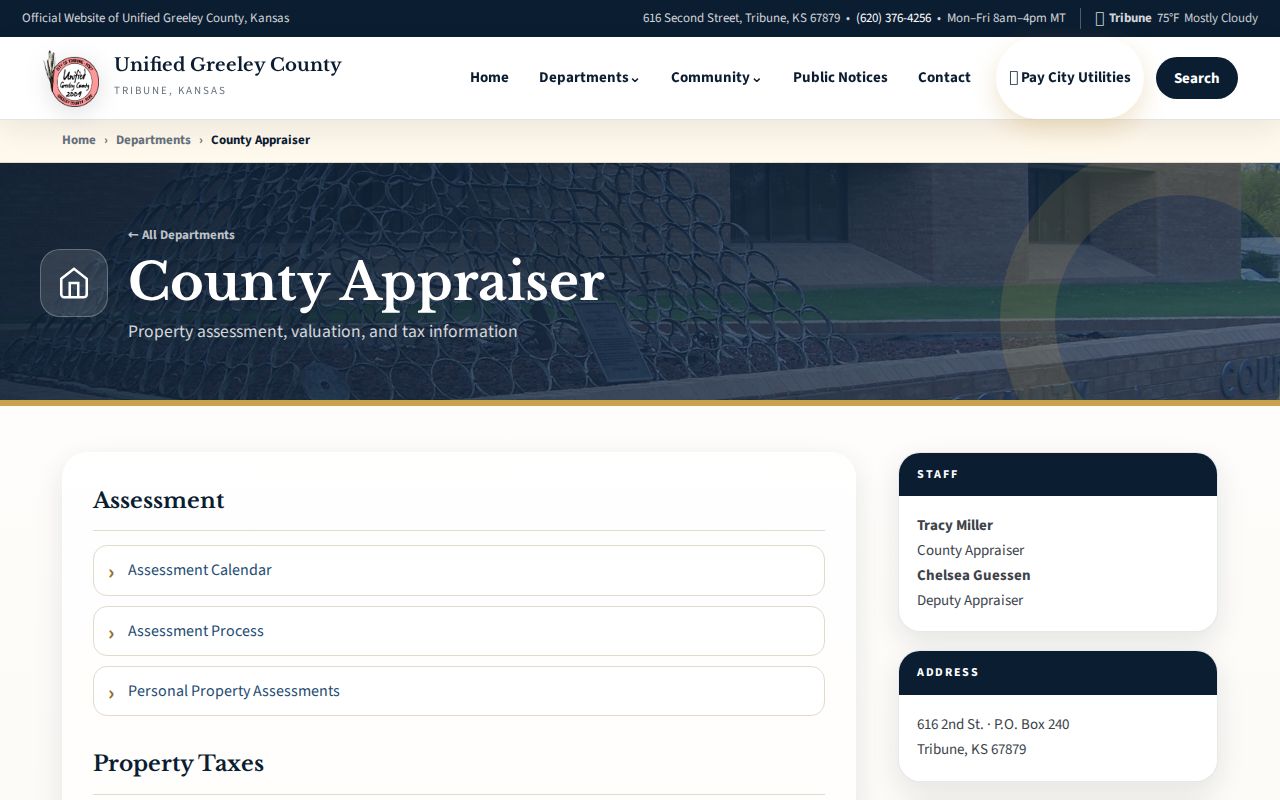
Use the page's office contact and assessment links. Then request the parcel fields directly instead of inferring data the page never displays.
Take a Greeley County Property Search to the Deed Index
The Register of Deeds page directs researchers to the office itself and lists warranty deeds, quitclaim deeds, mortgages and releases, liens and releases, easements, plats, and other instruments affecting real estate. No grantor-grantee form appears online. No image viewer appears either. Coverage start years and fee schedules stay offline too.
| Request field | Need | Useful variation | Expected locator |
|---|---|---|---|
| Party name | Required for a name search | Grantor, grantee, trust, or entity spelling | Index entry |
| Direction | Ask for both sides | Grantor and grantee indexes | Transfer path |
| Instrument type | Optional filter | Deed, mortgage, release, lien, easement, plat | Document class |
| Recording period | Bound the search | Ask for earliest available index | Recording date |
| Legal description | Strong match key | Town lot or rural land form | Tract match |
| Book/page or instrument | Best exact key | Copy from any prior hit | Plain or certified copy |
Ask about re-recordings, corrective deeds, assignments, and releases. A party name alone can mix people or entities, so lean on the legal description and the date to strengthen the match.
Inventory a Greeley County Property Search Result
Greeley County posts no sample parcel card online. When the office supplies one, capture every field rather than assuming a familiar layout from another Kansas county.
| Identity | Parcel/account ID, situs, tax unit, map reference, valuation year, and update date. |
|---|---|
| Ownership | Exact owner-of-record label and value, co-owner or entity, mailing address, and roll date. |
| Legal | Full legal description, acreage, subdivision or plat, lot and block, or section-township-range. |
| Values | Land, improvements, total appraised, assessed, class percentage, exemptions, and any agricultural-use value. |
| Sales | Recorded date, consideration if shown, instrument reference, and whether the transfer is classified as qualified. |
| Tax | Tax year, mill levy, billed and paid amounts, installments, delinquency, exemption, or sale flag. |
Some fields live in another office. The Appraiser describes value, the Treasurer handles payment, and the Register of Deeds holds the instrument. Record "not supplied" and move on. Never turn a missing field into a zero or a negative answer.
Choose the Best Greeley County Property Search Key
Address, owner, parcel number, and legal description answer different search needs. Start with the most exact fact in hand. Old spellings trip up searches. Keep a second key ready, because a record can carry an older spelling, an entity name, or a different address form.
| Starting key | Best use | County route | Common limit |
|---|---|---|---|
| Street address | Known physical site | Clerk or Appraiser | Historic or rural address may fail |
| Owner name | Known person, trust, or entity | Clerk, Appraiser, then Deeds | Same-name and spelling matches |
| Parcel/account | Exact appraisal or tax match | Appraiser and Treasurer | Format is not published |
| Legal description | Deed, plat, and tract matching | Deeds, Clerk, and map files | Must include every qualifier |
Not a title search. A Greeley County property search collects public evidence but does not insure clear title, resolve priority, or establish surveyed boundaries.
Search Tribune Lots and Rural Greeley County Tracts Differently
Tribune lots use their own terms. A January 2026 notice identified the south 57 feet of Lots 19 through 24, Block 69, First Addition, plus part of a vacated alley, and addition, block, lot, street, and alley-vacation words fill these records. A late-2025 notice cited Lots 9 and 10, Block 103, First Addition. Those exact strings beat a generic street reference.
Rural tracts need different vocabulary. Horace records differ again. Rural descriptions turn on section, township, range, quarter section, acreage, roads, creeks, mineral reservations, and easements, while historic Horace documents may use townsite, depot, railroad, right-of-way, or company terms. Ask whether the modern parcel description has an older survey or townsite counterpart.
- Addition
- A named platted expansion whose block and lot system must be kept with the city name.
- Section-township-range
- The public-land description used to locate rural tracts without relying on a street.
- Vacated alley
- A former public way whose later legal treatment can change the apparent tract and neighbor picture.
Cross-Check the Greeley County Clerk Ownership File
The Clerk's real-estate file is unusually helpful. Its own description names three access keys: address, legal description, and name. Ownership can also change outside deeds. The file lists probate, divorce decrees, and death certificates as transfer sources, which is why a deed-name search never tells the whole story.
Request the transfer source, filing date, property key, and current record date. Then go to the actual custodian. Inspect the underlying deed or court record there. The cross-file is not an archive of every deed, probate case, or certificate. Kansas vital records have separate eligibility rules. They are no public ownership shortcut.
Note: Use the Clerk file to connect sources, but cite the recorded instrument or court order when that document is the proof you need.
Search Greeley County Taxes by Account and Year
The Greeley County Treasurer handles billing but not online lookup. Its property-tax page lists deadlines and payment channels, not a public account search. Then contact the Treasurer for the exact tax year. Ask for both installments and billed and paid amounts. Request the payment date, delinquency, interest, and penalty too. Include any sale or foreclosure status. Request a receipt as well.
Statements go out each November. First-half payment is due December 20, the second half May 10. A lost statement does not erase the obligation, the county notes. Tax status alone never proves title. For ownership, carry the legal description back to the latest recorded deed.
A Missing GIS Changes the Greeley County Search Method
Greeley County publishes no official parcel GIS. No open parcel layer exists either. The KSDOT map shows highways, communities, city limits, and section context. It gives no parcel ID, owner, value, or boundary. A click will not name an owner.
The Appraiser or Clerk can supply the current parcel reference and any tax-unit map. The Register of Deeds holds recorded plats, replats, dedications, vacations, and easements tied to the legal description. Machine-readable parcels are another matter. A focused Kansas Open Records Act request can ask whether a polygon layer exists, what fields it carries, its update date, export format, and any lawful restriction.
Close a Greeley County Property Search With a Date Ledger
A finished search logs when each fact became true. Dates matter as much as data. Keep the deed execution and recording dates, the Clerk transfer-file date, the Appraiser valuation year, the Treasurer tax year and payment date, court filing and judgment dates, legal-notice publication date, and the map or plat date. Each office updates its own system on its own clock.
Resolve differences rather than trusting the newest screen. A deed may be recorded before the appraisal roll changes. A legal notice may announce a sale with no later deed. A court filing may end without the relief first requested. Ask each custodian for its "as of" date. Keep the response with your file. That record trail makes a Greeley County property search reproducible for purchase review, estate work, tax questions, or land history.
When a date is missing, ask. Do not estimate it. The county pages do not state the lag from deed recording to the Clerk file, Appraiser roll, or tax bill. A useful closing question asks whether a later transfer, correction, exemption change, payment, or court order is pending but not yet reflected. Save the office reply beside the result. If two files disagree, check the legal description. Return to the office responsible for that field. That final check keeps an ordinary update delay from turning into a false ownership or tax claim.